Overview
The 2026 Winter Olympics and Paralympic Games were held in February and March 2026 across 15 competition sites in northern Italy. The Games involved 3,500 attending athletes, referees, journalists, and thousands of other participants needing reliable transport to and from venues. The transport team behind the Games needed to plan for variable daily demand across multiple regions, with no room for errors that would disrupt the Games. Their prior spreadsheet-based process wasn’t built for that scale, so they turned to Optibus Planning, Scheduling, and Operations to plan and manage 140 bus lines serving up to 5,000 daily trips across 55 days of competition.
"We needed one platform that could keep up with a schedule that changed every single day of the Olympics. Optibus gave our team that real-time responsiveness we needed."
Eduard Rontgen, Bus Operations Manager
Challenge
Planning transport for the Winter Games meant moving athletes, referees, journalists, and other Olympic participants to venues across Lombardy, Veneto, and the mountain provinces – all on a competition schedule that changed daily. Before the Games, the transport team managed this route and timetable planning using spreadsheets. Evaluating and rolling out a single network change took significant manual effort, and the team had limited visibility into the network as a whole.
Compounding the challenge, planning data had to reach the Games’ driver app without errors, but manual data transfers between the planning tool and that system were producing incorrect data – a risk the team needed to eliminate before more than 400 vehicles hit the road.
Compounding the challenge, planning data had to reach the Games’ driver app without errors, but manual data transfers between the planning tool and that system were producing incorrect data – a risk the team needed to eliminate before more than 400 vehicles hit the road.
Solution
The organizing team implemented Optibus’s Planning, Scheduling, and Operations modules to run bus services for both the Olympic and Paralympic Games.
- The team used Optibus Planning to input routes and manage the different service levels required across 140 bus lines connecting official accommodations and competition venues.
- Rapid scenario creation allowed the planning team to simulate many potential scenarios months prior to the games starting
- Optibus’s cloud-native, AI-native platform used automation and analytics to speed up network changes, giving planners far greater scheduling accuracy and network visibility than the team’s previous spreadsheet-based process.
- Optibus also connected directly to the team’s driver app, automating the flow of planning data and closing the manual-transfer gap that had previously produced incorrect data.
- During the Games, the team used Optibus Operations to manage last-minute, real-time changes across all 12 bus depots, keeping the network responsive throughout 55 days of competition.
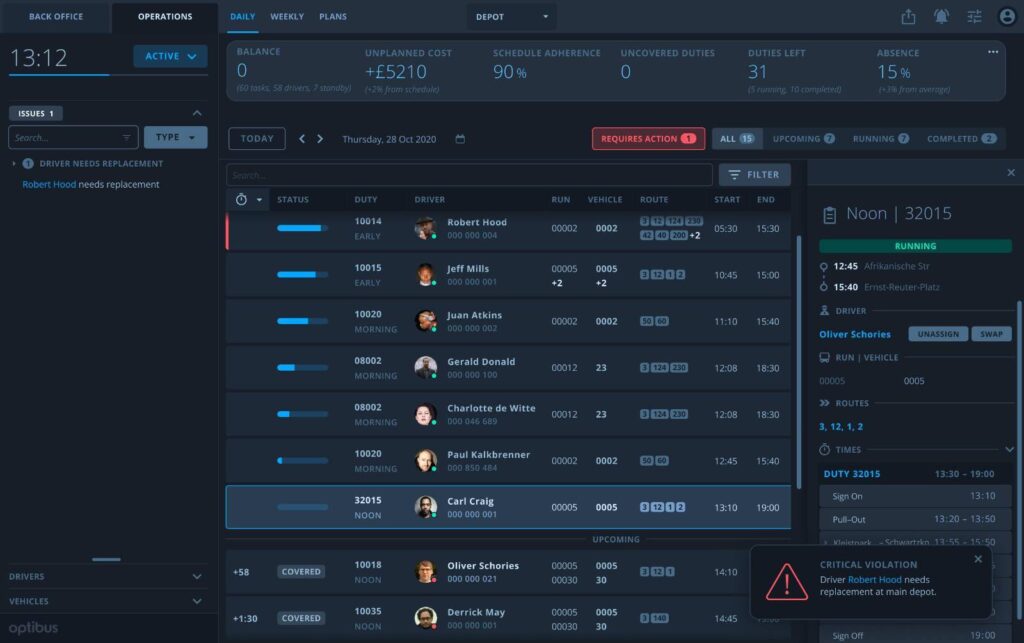
"It was critical that every service ran on time, that supply matched demand, and that nothing disrupted the Games. Optibus gave us a central, unified command center – visibility into everything, at every stage – so we could adjust service as needed and deliver something worthy of an international event the whole world is watching."
Stefano Manelli, Head of Transport
Results
Operational Efficiency
- Supported planning and delivery of 400 vehicles for the Olympics and 150 for the Paralympics — 2.6 million km and 600,000 km respectively – totaling 11,300 and 2,500 vehicle days
- Reduced errors and incorrect data involved in driver management and communication by eliminating manual work and automating the connection between Optibus and the team’s driver app
- Improved communication with multiple bus operators during the planning phase
Business Excellence
- Gave the organizing team a single, shared platform with which to coordinate and share transport plans and service changes with stakeholders, including local and federal government and international organizations
Service Quality & Network Performance
- Provided disruption-free bus service to thousands of passengers – up to 5,000 daily one-way trips at peak – for 55 days using real-time transport management tools for last-minute scheduling and demand changes